A Researcher Shaped by Different Cultures, Methods, and Questions
My research journey began at 19, when I conducted qualitative and quantitative fieldwork with urban communities in Brazil. Since then, I have studied and conducted research across Brazil, France, India, and the United States, bringing together academic inquiry, cross-cultural experience, and international market research.
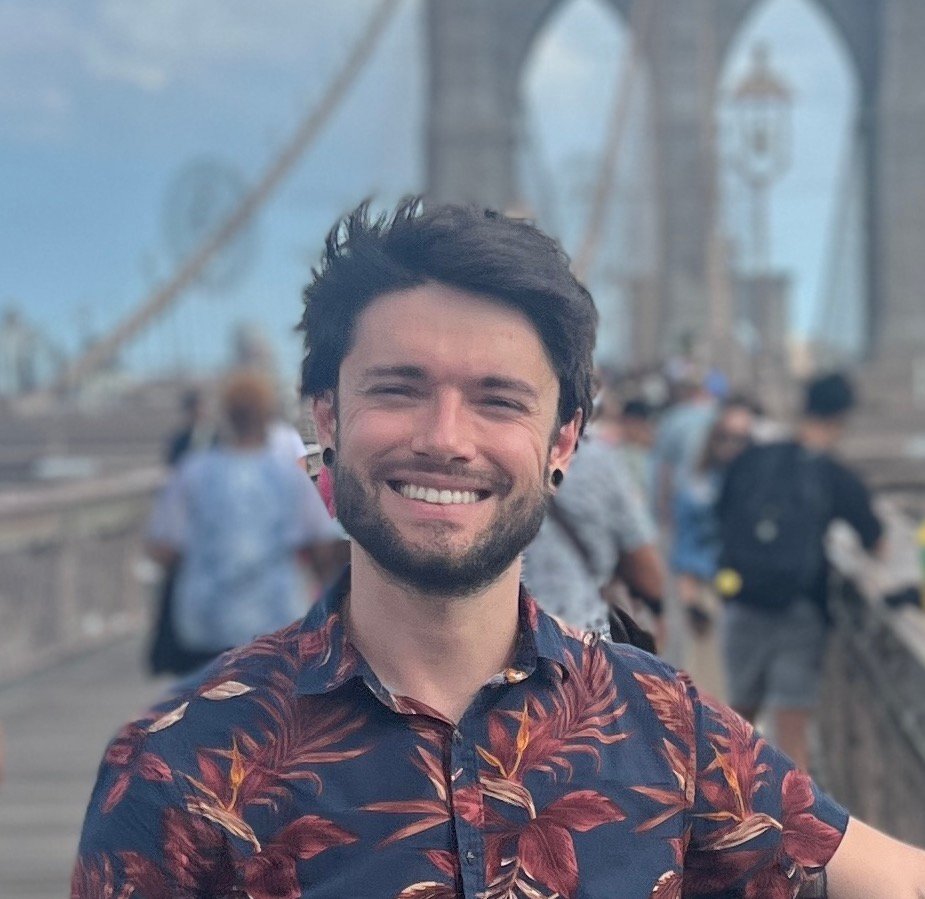
Today, I work with international research teams conducting studies in Brazil, combining rigorous research practice with practical project execution.
Where Research Began
My research career began at 19, when I joined the Gender and Sexuality Research Laboratory at the State University of Santa Catarina (UDESC) as an undergraduate researcher. I became part of a multidisciplinary study on contraceptive practices and abortion in an urban low-income community in Florianópolis.
Working closely with the project’s lead researcher, I was involved in the study from research planning through fieldwork and analysis. I coordinated field logistics and participated in 30 in-depth interviews and three focus groups, working directly with participants, researchers, and the local community.
The quantitative component gave me my first experience with research design and sampling. I participated in planning the fieldwork for approximately 4,000 face-to-face questionnaires and personally conducted around 400 PAPI interviews with randomly selected households across the community.
After fieldwork, I worked with both qualitative and quantitative data, learning transcription, qualitative data organization and tabulation, report writing, and the process of turning research findings into a published study. I also participated in research discussions and study groups throughout the project, gaining an understanding of how evidence is interpreted and translated into research outputs.
From Fieldwork to Publication
The research culminated in the publication of Histórias que Ninguém Conta: Aborto e Contracepção em Grupos Populares Urbanos, a collaborative book based on the fieldwork conducted in Florianópolis. The project brought together research findings from multiple disciplines and several years of fieldwork and analysis into a published contribution to the study of reproductive health and urban communities.
Training in Qualitative Inquiry
My academic training in Cultural History also shaped the way I approach qualitative research. Historical research relies heavily on interviews, oral histories, documents, and other primary sources, and throughout my undergraduate studies I developed a strong foundation in qualitative interviewing, source analysis, and historical interpretation.
For my undergraduate thesis, I examined the reception of Queer Theory in Brazil, tracing how queer ideas emerged, circulated, and were debated in the country. My undergraduate thesis, titled A Bicha Louca Está Fervendo, was later recognized beyond its original undergraduate context. Richard Miskolci cited the work in his discussion of the genealogy of Queer Theory in Brazil, describing it as an “excellent undergraduate thesis.” In 2017, Brazilian scholar Denilson Lopes referred to it as “the most complete survey of Queer Studies in Brazil” in his chapter “In Search of a New Invisibility,” (p. 167) published by Routledge in Literature and Ethics in Contemporary Brazil.
International Academic Research Training
My academic path has taken me across different educational and cultural environments in Brazil, Europe, South Asia, and the United States. These experiences shaped how I approach research, exposing me to different intellectual traditions, research methods, and ways of understanding people and societies.
France
In 2012, while studying Cultural History at UDESC, I spent a year at the Université de Versailles Saint-Quentin-en-Yvelines in France. It was my first experience studying within a different academic system and an early introduction to learning and conducting research across cultures.
India
In 2016, I moved to India to pursue an M.A. in Buddhist Studies, Philosophy, and Comparative Religion at Nālandā University. The experience took my research in a very different direction: instead of contemporary communities and social questions, I began working with historical sources and the transmission of knowledge across centuries.
My research focused on the history of Buddhism in India between the eighth and twelfth centuries. I worked with primary textual sources alongside the historiography produced by Indian scholars during the early decades of the Republic, developing experience in archival research, textual analysis, and historical interpretation.
Studying in India gave me firsthand experience of a research environment shaped by intellectual traditions very different from those in Brazil and Europe. It reinforced an approach that has remained central to my work: understanding a question within its cultural and historical context before drawing conclusions from the evidence.
View my Nālandā University profile →
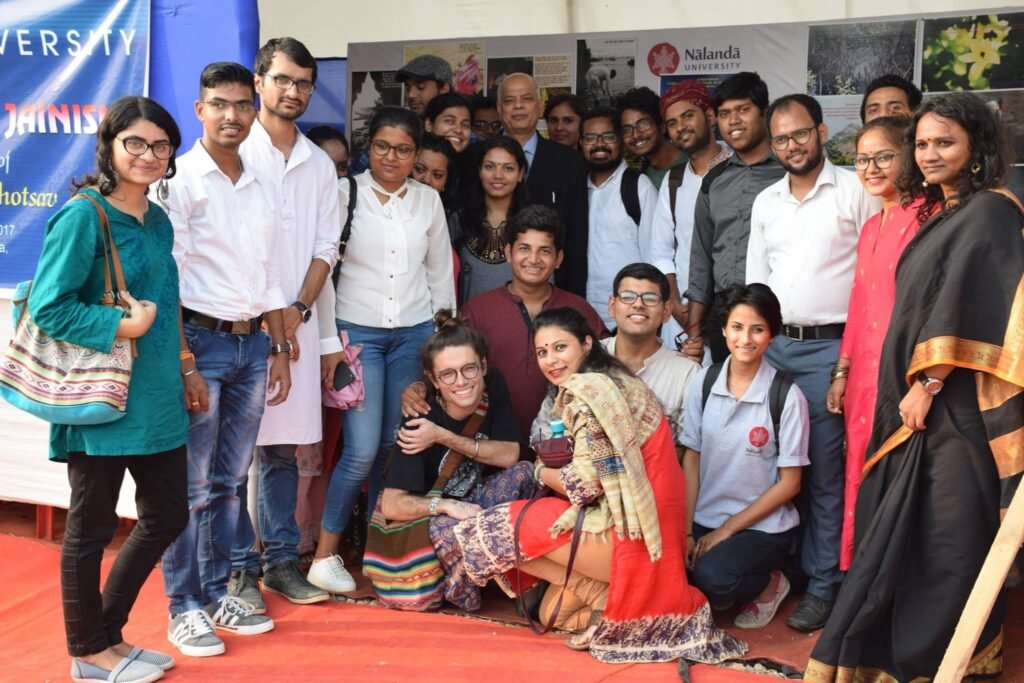
Studying at Nālandā University, India, as part of an international academic community.
Nepal
Between India and the United States, I spent a year at the Rangjung Yeshe Institute in Kathmandu, studying Buddhist traditions and working as a Teaching Assistant for introductory courses in the history of Buddhist cultures. The experience added another dimension to my international academic formation: learning not only how knowledge is produced, but how it is taught and communicated across different audiences.
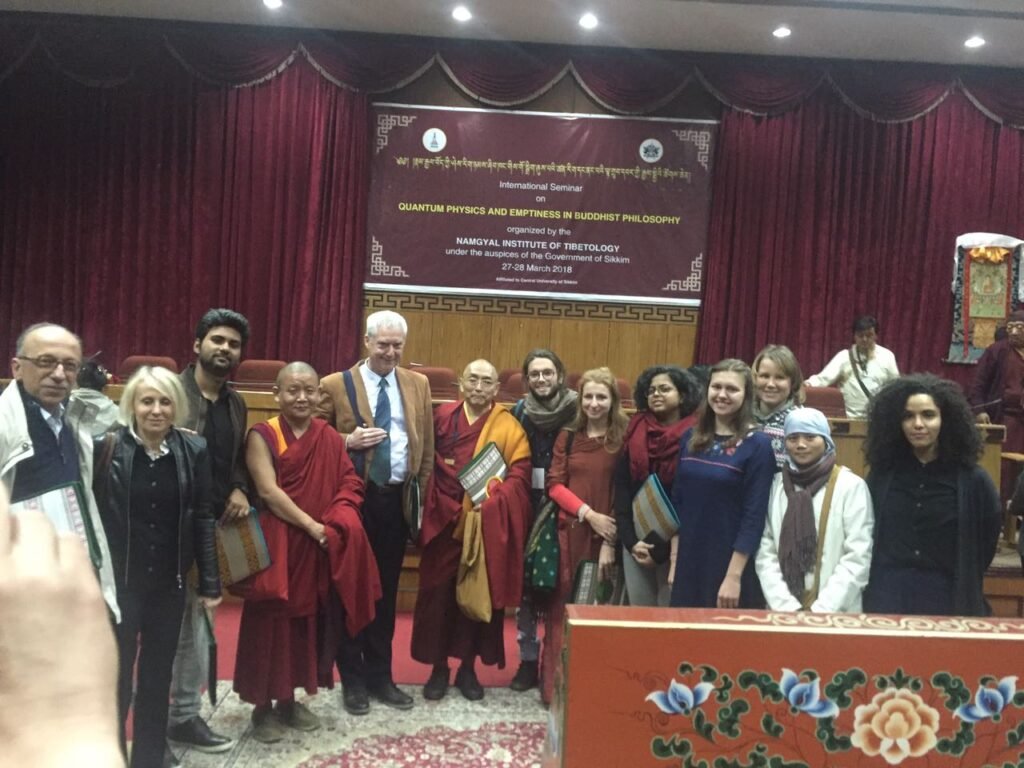
Participating in Academic Congress with Professor Allan Wallace, scholars and colleagues.
Harvard — An Interdisciplinary Education
In 2019, I began my Master of Divinity at Harvard Divinity School, completing the degree in 2023. During my time at Harvard, I expanded my academic training across leadership, community organizing, education, public health, humanitarian response, and nonprofit work.
I studied across Harvard Kennedy School, Harvard Graduate School of Education, Harvard Faculty of Arts and Sciences, and Harvard T.H. Chan School of Public Health. At the School of Public Health, I worked as a Teaching Assistant for Leadership in Public Health and pursued studies in humanitarian response and international NGOs, ultimately completing the Humanitarian Studies Concentration.
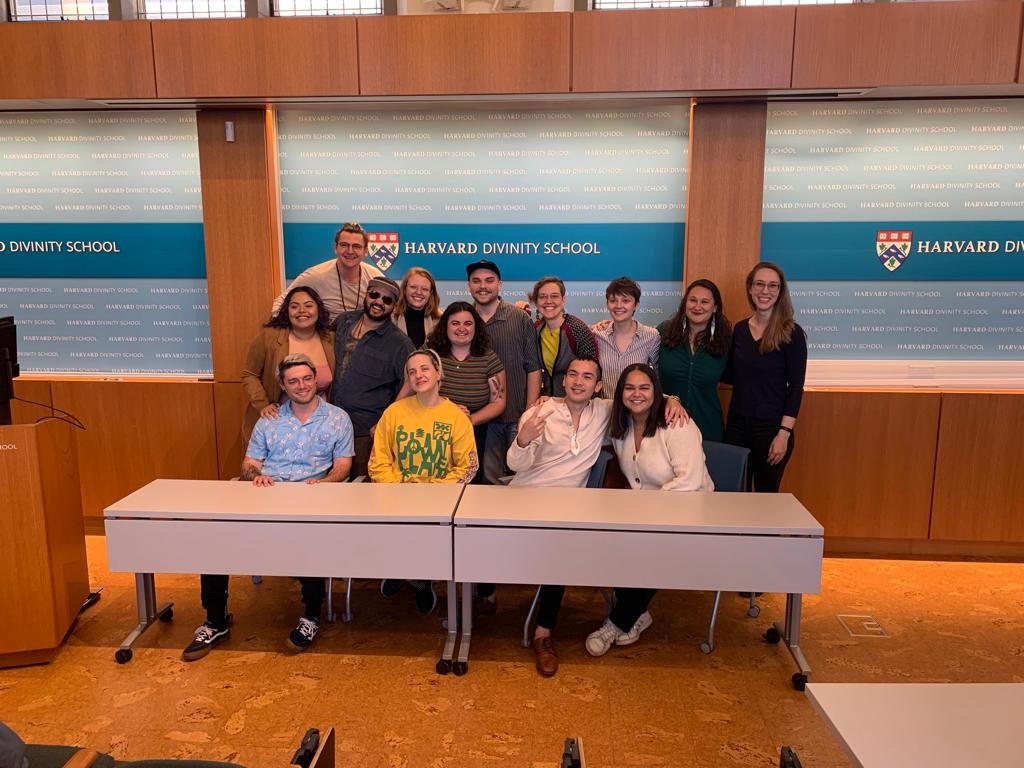
Harvard Divinity School, where I completed my Master of Divinity in 2023.
I also gained my first professional experience in the United States as a Project Manager, through internships with a nonprofit supporting Brazilian immigrants in Massachusetts and at Cambridge Health Alliance’s Center for Mindfulness and Compassion. These experiences gave me early exposure to project management, nonprofit operations, and health-related work in U.S. organizations.
Beyond the classroom, I served on the Student Advisory Board of Harvard’s Radcliffe Institute for Advanced Study. My interdisciplinary work also led to a publication in the Harvard Review of Psychiatry, examining justice in gender-affirming healthcare.
My graduate work also continued my research and writing practice. My final project, Spiritual Discernment: A Journey Towards Initiation in the Santo Daime Tradition, combined autobiographical narrative with critical reflection and research. Harvard Divinity School later featured my experience in its Graduate Profile series.
Speaking at Harvard Divinity School during the 2023 Commencement ceremonies.
Watch the full commencement program →
A Researcher Shaped by Multiple Systems
By the time I reached Harvard, I had studied and worked within academic environments in Brazil, France, India, Nepal, and the United States. These were not simply international credentials; they were years of living, studying, researching, teaching, and working within different cultural and intellectual environments.
This is what I mean when I describe myself as an international researcher. My perspective was shaped internationally before my career in market research ever became international. I learned that the questions people ask, the assumptions they bring, the way evidence is interpreted, and the expectations placed on research can differ significantly across cultures.
From Academic Research to Market Research
My transition into market research began during my time at Harvard. I was introduced to business through Harvard Business School Online‘s Credential of Readiness (CORe), my first formal exposure to business and management. I completed the program in 2020.
Soon afterward, the COVID-19 pandemic changed the professional landscape. As I began looking for new opportunities, I found my way into market research and joined SIS International Research.
What had begun more than a decade earlier as an academic research career became a professional career in international market research, bringing together research methodology, cross-cultural understanding, and project execution.
SIS International Research
Project Manager | 2021–2024
At SIS International Research, I moved from academic research into the operational reality of large-scale international market research. I managed qualitative and quantitative projects across multiple markets, working with global research agencies and clients on recruitment, fieldwork, project management, moderation, quality control, and respondent management.
My work covered a wide range of audiences — from consumers and patients to healthcare professionals, business owners, executives, and senior decision-makers — across industries including healthcare, technology, financial services, retail, food and beverage, and professional services.
Over this period, I contributed to 200+ research projects across international markets, managing projects ranging from small, highly specialized interviews to multi-country studies involving hundreds of participants.
The work required more than recruitment. I was responsible for translating research specifications into executable fieldwork, identifying and screening participants, coordinating moderators and partners, managing schedules and incentives, monitoring quality, communicating with clients, and adapting research operations to local market conditions.
A documented sample
Project files from this period live primarily in SIS’s internal systems. For 83 of these 200+ projects, I kept my own complete documentation — the figures below come directly from those records, not from memory or estimation.
83 projects documented in full
70 clients served
8,893 participants recruited
$1.75M+ in project budgets managed end-to-end
39 markets covered
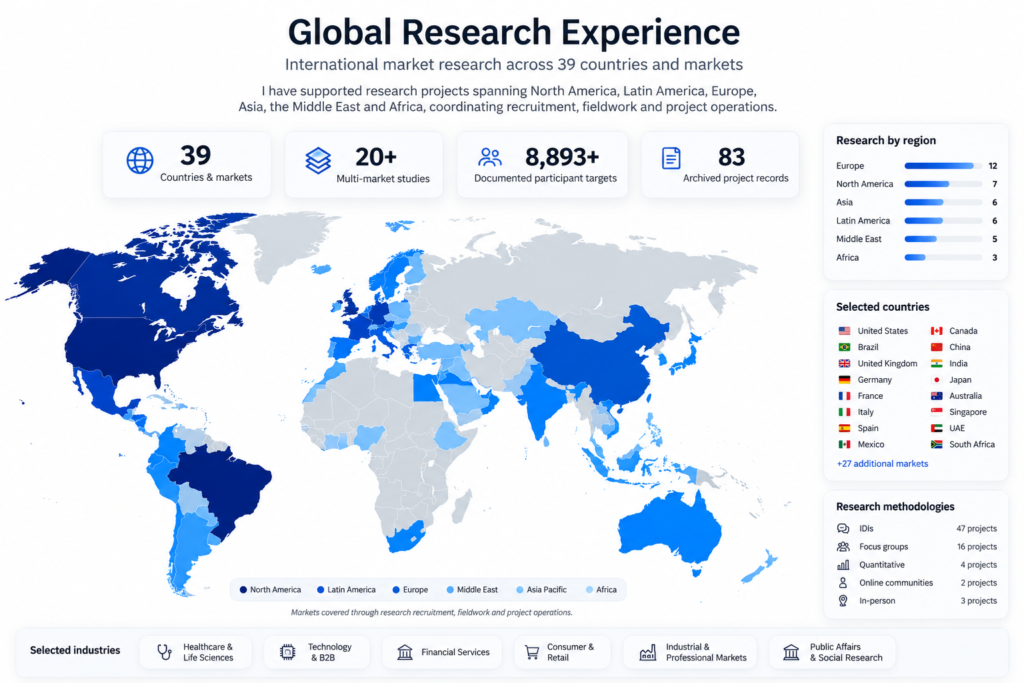
Countries and markets represented in documented projects, including recruitment, fieldwork, moderation and research operations.
Methodologies
47+ — IDIs
16+ — Focus groups
4+ — Quantitative projects
2+ — Online communities
2+ — Explicitly in-person projects
Selected industries & research contexts
These projects covered a broad range of research formats and audiences, from highly specialized one-to-one interviews with physicians, engineers, executives, and other professionals to focus groups, online communities, in-person research, and larger-scale qualitative and quantitative studies.
Healthcare & Life Sciences
Pharmaceuticals · Medical Devices · Diagnostics · Digital Therapeutics · Hospitals · HCPs · Patients
Technology & B2B
Software · IT · Digital Services · Business Solutions
Financial Services
Banking · Investment · Payments · Financial Technology
Consumer & Retail
Retail · Restaurants · Food & Beverage · Consumer Products · E-commerce
Industrial & Professional Markets
Manufacturing · Engineering · Construction · Aerospace · Automotive
Public Affairs & Social Research
Politics & Policy · Media · Disinformation · Opinion Research
From Recruitment to Research Operations
My role increasingly extended beyond finding respondents. I learned to treat recruitment and fieldwork as an integrated research operation: interpreting complex specifications, designing practical recruitment approaches, building screening processes, coordinating international partners, managing schedules and incentives, monitoring quality, and communicating directly with clients.
Working across different markets also meant adapting the operation to local realities. A methodology that works in one country may require a different recruitment channel, partner structure, screening approach, or respondent-management strategy elsewhere.
This experience became the foundation for the way I approach research today: combining research methodology with hands-on operational execution.
Research Today
Today, I work as a Custom Recruitment Coordinator at M3 Global Research, continuing my career in international market research and research operations.
Alongside my work at M3, I work independently with international research teams and clients, supporting projects in Brazil across recruitment, fieldwork, moderation, project management, and research operations.
For these independent projects, I coordinate a small network of independent researchers and fieldwork partners, bringing together the people and local capabilities needed for each study. Depending on the project, this can include recruitment, screening, interviewing, moderation, scheduling, quality control, and other fieldwork activities.
This allows me to operate beyond the role of an individual researcher. I can assemble and coordinate the right resources for each project, while remaining directly involved in research operations and client communication.
My work today sits at the intersection of research methodology, international collaboration, and fieldwork execution— helping research teams turn complex research objectives into practical, well-executed studies.